
This annual report will be presented to Parliament to meet the statutory reporting requirements of the Compulsory Third Party Insurance Regulation Act 2016.
This report is verified to be accurate for the purposes of annual reporting to the Parliament of South Australia.
David Price
Chief Executive & CTP Regulator
From the Chief Executive
The past year the Regulator team has worked diligently to maintain an efficient CTP Scheme by focusing on technological enhancements to benefit injured people, motorists and the South Australian community.
The team focus on Scheme data has driven improvements in claims management and injury recovery outcomes. This included using existing Scheme data to gain additional insights and explore opportunities for improvement by developing new metrics and exploring refinements to the use of existing data points. This past year’s work has laid the foundations for deeper understanding of injured peoples’ experience in the Scheme to guide further improvement of supports for claimants with their injury recovery.
The team reviewed and enhanced the Allied Health Management Plans used by treatment providers to request funding for treatment, care and support in the Scheme. The review resulted in the release of new, improved plans designed to ensure timely and clear funding decisions. These enhancements are expected to promote a more streamlined, holistic, and evidence-based approach to treatment funding decisions in the Scheme. As a focus for this year, we have deepened our engagement with key stakeholders—particularly health providers—to promote early intervention and better outcomes for injured people.
We commenced our exploration into the potential benefits artificial intelligence (AI) presents for the Scheme, particularly in the use of Scheme data. Our first AI program was implemented and underscores our commitment to leveraging technology to enhance Scheme efficiency. We are supporting our team to identify other ways AI may further enhance efficiency and insights. The AI exploration was coupled with proactive monitoring of CTP Insurer’s technological innovations to ensure that they are well-governed and ultimately benefit injured people and motorists. While innovation presents exciting opportunities, we remain focused on ensuring that all changes serve the best interests of the community.
Our efforts to streamline operations extended to the CTP Insurer Compliance Management System, which serves as the repository for all insurer audit and compliance activity records. Recent enhancements to this system have simplified compliance processes and improved the overall management of audits and related activities, contributing to greater operational efficiency.
We continue to focus on ensuring CTP premiums remain fair and reasonable, with the majority of South Australian motorists seeing minor increases in their premiums well below inflation, reflecting the ongoing efficiency and sustainability of the competitive, privately underwritten Scheme. As of 1 July 2025, the lowest available 12-month metropolitan private passenger vehicle premium is 14% of South Australian average weekly earnings, a notable decrease from 27% when the current Scheme began in 2016.
To further inform our initiatives and drive continuous improvement, we expanded on our regular surveying of claimants to delve deeper into the injury recovery experience and experience with treatment providers. We also surveyed insurer staff to gain their insights into the Scheme. These findings will inform the Regulator’s initiatives to further improve scheme experience in the coming year, with a focus on improving public awareness, understanding and scheme accessibility.
I look forward to working with my dedicated team and all scheme stakeholders to ensure the Scheme continues to evolve and deliver for injured people, motorists and the South Australian community.
Overview
The Compulsory Third Party (CTP) Insurance Scheme is governed by South Australian legislation in the following Acts of State Parliament: Motor Vehicles Act 1959 (MV Act), Civil Liability Act 1936 (CL Act) and Compulsory Third Party Insurance Regulation Act 2016 in addition to contracts between the State and government approved insurers (CTP Insurers).
The CTP Regulator oversees the Scheme and regulates the CTP Insurers, AAMI, Allianz, QBE, NRMA and Youi. Fundamental aspects of the Scheme are to support the recovery of people injured in motor vehicle accidents and provide a compulsory Policy of Insurance (policy) to protect motor vehicle owners against the financial impact of causing personal injury or death to other road users through the use of their vehicle anywhere in Australia.
CTP insurance is paid for at the same time as motor vehicle registration. The policy attaches to the vehicle, not the purchaser. The minimum terms and conditions of the policy, set by the Regulator, are available on the Regulator’s website: www.ctp.sa.gov.au.
Motorists actively choose their CTP Insurer based on factors including price, brand, claimant service rating and approved incentives. The CTP Insurers underwrite the South Australian scheme and manage claims against the policy.
In South Australia, claims for compensation under the Scheme are fault-based common law claims modified by statute, primarily the CL Act. This means injured road users may be eligible for injury recovery support, payment of reasonable and necessary treatment and compensation when another party is at fault or partially at fault. Access to compensation requires the injured person’s injuries to meet injury severity thresholds.
The Regulator is appointed as the Nominal Defendant under Part 4 of the MV Act. Nominal Defendant claims occur when a vehicle involved in a motor vehicle accident in South Australia, which causes injury or death to other road users, is uninsured or cannot be identified. The Regulator assigns management of Nominal Defendant claims to the CTP Insurers in line with their market shares.
The Scheme also provides funding for reasonable and necessary treatment, care and support for children injured while under the age of 16 years in an accident in South Australia, regardless of fault.
The CTP Scheme is complemented by the Lifetime Support Scheme which operates separate from the CTP Scheme. The Lifetime Support Scheme is a no-fault scheme which provides treatment, care and support for people who have sustained very serious injuries in motor vehicle accidents in South Australia.
The Regulator is established as an independent statutory authority under the Compulsory Third Party Insurance Regulation Act 2016 (the Act). The Regulator’s functions are set out in section 5(1) of the Act.
The Regulator is responsible for:
- regulating CTP Insurers
- monitoring and reviewing the operation and efficiency of the CTP Scheme
- oversight, monitoring and reporting of CTP Insurer activities
- determining the minimum terms and conditions of the policy of insurance
- determining CTP premiums
- providing information to consumers about the Scheme and CTP Insurers.
To deliver a fair and competitive CTP Scheme with choice, ease and confidence for the South Australian community.
To provide community confidence in the Scheme by regulating CTP Insurers and monitoring the performance of the CTP Scheme.
| Our values | What this means for us |
|---|---|
| Outcomes driven |
|
| Accountable |
|
| Collaborative |
|
| Fair |
|
| Supportive |
|

Changes to the CTP Regulator
During 2024-25, the process of determining premium ranges was transferred to the portfolio of Director, Analytics and Performance.
David Price is the Chief Executive (CE) and CTP Regulator (Regulator), responsible for carrying out the functions of the Regulator and the CE as determined by the Compulsory Third Party Insurance Regulation Act 2016. The Regulator is also the Motor Accident Injury Accreditation Scheme (MAIAS) Administrator.
Meghan Ritchie is the Director, Strategy and Governance, responsible for scheme research and policy, providing information to motorists and overseeing corporate functions including finance.
Ivan Lebedev is the Director, Analytics and Performance, responsible for information systems, data analytics, monitoring the Scheme, CTP Insurer performance, MAIAS and the process of determining premium ranges for premium classes.
- Compulsory Third Party Insurance Regulation Act 2016
- Part 4, Motor Vehicles Act 1959.
The Regulator has a service level agreement with the Department of Treasury and Finance (DTF) for the provision of corporate services to keep administration costs down and support the effective functioning of the Regulator’s office.
Our significant relationships to support scheme efficiency and administration are with the:
- Department for Infrastructure and Transport for the collection and disbursement of CTP premiums
- Lifetime Support Authority to improve recovery outcomes for injured people
- ReturntoWorkSA to share Scheme learnings, emerging issues and collaborate on shared initiatives to support injured people
- Australian Prudential Regulation Authority to monitor the financial stability and solvency of the CTP Insurers.
In 2024-25, the Regulator maintained arrangements with government agencies to provide the following services to the Scheme:
- Health and Emergency Services: SA Local Health Networks; SA Ambulance Service; State Rescue Helicopter Service; Forensic Science SA
- Road safety: South Australia Police and Department for Infrastructure and Transport
- Customer support and transaction processing: Department for Infrastructure and Transport.
These arrangements are funded from the administrative component of CTP premiums, collectively known as the CTP Scheme Services fee (detailed on page 31).
CTP Regulator stakeholders:
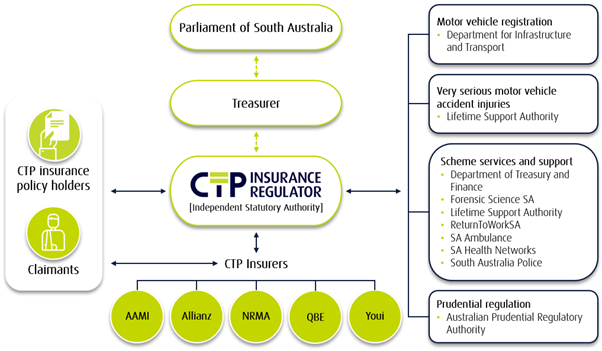
The Regulator is appointed as the Motor Accident Injury Accreditation Scheme (MAIAS) Administrator by the designated Minister under section 76 of the Civil Liability Act 1936. The MAIAS Administrator has administrative and financial responsibility of the MAIAS which was established to accredit health professionals to undertake Injury Scale Value (ISV) medical assessments.
An ISV medical assessment is used to assist in determining an injured road user’s entitlement to compensation by assigning referred injuries to ISV item numbers listed in Schedule 1 of the Civil Liability Regulations 2013. The ISV is a number between 0 and 100 that reflects the level of adverse impact of the injury on the person, based on medical evidence.
The Administrator uses the MAIAS Rules to oversee the performance of the accredited medical practitioners. The Rules prescribe the regulatory and service standards required for medical practitioners to achieve and maintain accreditation.
The key objective of MAIAS is to create an independent system that provides consistent, objective and reliable ISV medical assessments. As Administrator, the Regulator’s responsibilities include but are not limited to:
- prescribing the processes and documentation of the MAIAS including accreditation training courses and overseeing their implementation
- supporting Accredited Medical Practitioners (AMPs) and monitoring their performance to verify conformity with accreditation obligations
- making recommendations to the Minister for approval of applicants who meet the accreditation criteria
- maintaining and keeping an up-to-date register of all AMPs
- continuing oversight of the MAIAS.
The Regulator’s performance
In 2024-25, the Regulator continued to deliver on its strategic objectives to support the efficiency of the Scheme. Highlights include:
- Redetermined CTP premium bands with the majority of South Australian motorists seeing premium increases below inflation, reflecting the ongoing efficiency and sustainability of the competitive, privately underwritten Scheme.
- Conducted insurer audits to monitor compliance of CTP Insurers with the contractual and legislative obligations of the Scheme. See page 20 for more detail.
- Expanded on our regular surveying of claimants to delve deeper into the injury recovery experience, experience with treatment providers and surveyed insurer staff to gain their insights into the Scheme. See page 24 for more detail.
- Enhanced use of scheme data to drive improvements in claims management and injury recovery outcomes. See page 24 for more detail.
- Reviewed Allied Health Management Plans. These plans are used by insurers to assist providers to request funding for treatment, care and support for injured people. See page 25 for more detail.
- Increased engagement with health providers to promote early intervention and improve recovery outcomes for injured people. See page 27 for more detail.
The Regulator’s strategic objectives support delivery of statutory functions under section 5 of the Compulsory Third Party Insurance Regulation Act 2016.
The Regulator’s performance against strategic objectives is summarised below.
Performance indicator Objective 1: Oversee a financially sustainable, effective and efficient scheme | Target date | Outcome |
|---|---|---|
Explore opportunities to convert scheme data into actionable insights (see page 24) | June 2025 | ✓Achieved |
Explore the viability of implementing risk screening and data reporting, and monitoring how risk factors change, throughout the life of the claim, to promote a biopsychosocial lens to injury recovery (see page 24) | June 2025 | ✓Achieved |
Plan and prepare the Scheme for emerging technologies and participate in Across Government automated vehicle reform working groups (see page 26) | December 2028 | On track |
Objective 2: Promote an outcome driven, early recovery and service focused approach to claims management | ||
Review Allied Health Management Plans (see page 25) | May 2025 | ✓Achieved |
Review how working injured people with CTP claims return to work to monitor and encourage insurer supports (see page 24) | June 2025 | ✓Achieved |
Develop a customer insights framework to support customer-centric decisions based on consumer insight research | December 2024 | ✓Achieved |
Research, identify and implement injury recovery and scheme experience initiatives that improve outcomes and experience of injured people in the Scheme (see page 24) | June 2025 | ✓Achieved |
Explore and implement Motor Accident Injury Accreditation Scheme quality assurance program efficiencies (see page 28) | June 2025 | ✓Achieved |
Objective 3: Deliver a customer-centric focus | ||
Explore opportunities in artificial intelligence and how these can be applied to benefit the Scheme (see page 25) | June 2026 | On track |
Review insurer technological improvements to understand application in the CTP Scheme and potential impacts for policyholders and claimants (see page 22) | June 2025 | ✓Achieved |
Strengthen Regulator staff skills in communicating with vulnerable people | June 2025 | ✓Achieved |
Objective 4: Enhance the capability of the team | ||
Promote staff participation in targeted training and development opportunities (see page 14) | June 2025 | ✓Achieved |
Implement strategies to strengthen our resilient and contemporary team | June 2026 | On track |
Provide opportunities to develop staff capability through cross-skilling across teams | June 2026 | On track |
Implement a plan to action recommendations from the 2024 People Matter Employee Survey | June 2025 | ✓Achieved |
Capacity building placement
The Regulator’s Capacity Building Placement program creates an opportunity for people with disability to gain employment skills and confidence in a supportive environment. The program also works towards building a diverse and inclusive public sector where everyone belongs.
The program aligns with the Government of South Australia’s commitment to improving outcomes for people with neurodivergence and the objectives of the Office for Autism. The program aims to support strengthening the capability and confidence of the participant to compete in the jobs market and provides a blueprint to share with government agencies to establish similar programs.
The current participant has expanded their work to include gaining experience in the Information Technology branch of the Department of Treasury and Finance, in addition to their administration-focussed work within the Regulator’s office. This is providing more opportunity in areas of particular interest to the current participant.
Regulator staff are employed by DTF and seconded to the Regulator. Accordingly, Regulator staff access DTF performance discussion and development systems, including the organisational development tool, myCareer. All staff have individual performance plans in place that are discussed at least every six months.
Staff training
Regulator staff participated in training and development opportunities throughout the year to enhance the team’s knowledge and capabilities, including:
- Aboriginal cultural capability training
- Communicating with vulnerable people workshop
- Kaurna language workshop
- Presentation on DTF’s Psychosocial Wellbeing Framework
The Regulator aims to promote the health and safety of staff by maintaining systems and practices designed to prevent injuries and illnesses, as well as support overall wellbeing and psychosocial health.
As secondees from DTF, Regulator staff access DTF’s work health, safety and return to work programs.
Regulator staff work health and safety breaches, workplace injury claims, notifiable incidents or improvement and prohibition notices are recorded and reported in the DTF annual report.
| Executive classification | Number of executives |
|---|---|
| SAES Level 1 | 2 |
| SAES Level 2 | 1 |
The Office of the Commissioner for Public Sector Employment (external site) has a workforce information (external site) page that provides further information on the breakdown of executive gender, salary and tenure by agency.
Financial performance
The following is a summary of the overall financial position of the Regulator. The information is unaudited. Full audited financial statements for 2024-2025 are attached to this report.
Statement of comprehensive income | 2024-25 Budget $000s | 2024-25 Actual $000s | Variation $000s
| 2023-24 Actual |
|---|---|---|---|---|
Total income | 71,634 | 75,962 | 4,328 | 74,443 |
Total expenses | 71,634 | 73,341 | 1,707 | 67,369 |
Net result | 0 | 2,621 | 2,621 | 7,074 |
Total comprehensive result | 0 | 2,621 | 2,621 | 7,074 |
Statement of financial position | 2024-25 Budget $000s | 2024-25 Actual $000s | Variation $000s
| 2023-24 Actual |
|---|---|---|---|---|
Current assets | 59,155 | 56,142 | (3,013) | 55,391 |
Non-current assets | 236 | 184 | (52) | 235 |
Total assets | 59,391 | 56,326 | (3,065) | 55,626 |
Current liabilities | 14,008 | 8,296 | (5,712) | 10,244 |
Non-current liabilities | 526 | 553 | 27 | 526 |
Total liabilities | 14,535 | 8,849 | (5,685) | 10,770 |
Net assets | 44,856 | 47,477 | 2,621 | 44,856 |
Equity | 44,856 | 47,477 | 2,621 | 44,856 |
The following is a summary of external consultants that have been engaged by the Regulator, the nature of work undertaken, and the actual payments made for the work undertaken during the financial year.
Consultancies with a contract value below $10,000 each
Consultancies | Purpose | $ Actual payment |
|---|---|---|
All consultancies below $10,000 each - combined | Various | 0 |
Consultancies with a contract value above $10,000 each
Consultancies | Purpose | $ Actual payment |
|---|---|---|
Scyne Advisory Pty Ltd | Internal audit and accounting advice services | 55,208 |
Taylor Fry Pty Ltd | Actuarial services | 400,011 |
Total | 455,219 |
See also the Consolidated Financial Report of the Department of Treasury and Finance (external site) (PDF) for total value of consultancy contracts across the South Australian Public Sector.
The following is a summary of external contractors that have been engaged by the agency, the nature of work undertaken, and the actual payments made for work undertaken during the financial year.
Contractors with a contract value below $10,000
Contractors | Purpose | $ Actual payment |
|---|---|---|
All contractors below $10,000 each - combined | Various | 10,401 |
Contractors with a contract value above $10,000 each
Contractors | Purpose | $ Actual payment |
|---|---|---|
BIZ HUB Australia Pty Ltd | CTP Claims Register system support and development | 54,230 |
CyberCX Pty Ltd | Third party risk assessment | 27,000 |
Exposé Data Pty Ltd | AI platform training | 21,000 |
Haymakr | CTP claimant survey services | 59,545 |
Total | 162,475 |
The details of South Australian Government-awarded contracts for goods, services, and works are displayed on the SA Tenders and Contracts website. View the agency list of contracts (external site). The website also provides details of across government contracts (external site).
Risk management
The Regulator’s Risk and Audit Committee meets quarterly to monitor risk management within the organisation and provide assurance to the Governance Committee on the operation and effectiveness of the Risk Management Framework and internal and external audit activities.
The Regulator also reports annually to the Department of Treasury and Finance (DTF) Risk and Performance Committee.
In the past year, the Regulator’s Risk and Audit Committee fulfilled its responsibilities as set out in the terms of reference, including:
- monitoring the currency and effectiveness of the Regulator’s internal control systems and compliance with applicable laws, regulations, standards, and best practice guidelines, including:
- maintaining the Risk Management Framework, risk management systems and processes
- reviewing and updating the Regulator’s Business Continuity Plan
- monitoring the Regulator's adherence to its legislated and contractual obligations
- monitoring the implementation of the Cyber Security Plan.
- overseeing and monitoring Regulator’s internal compliance activities, including the 2024-25 internal audit plan (external independent auditor)
- acting on the independent review of strategic risks by external auditor
- reviewing and recommending updates to the risk appetite statement.
The Regulator is committed to sound cyber security governance and protection of scheme data. Key actions for 2024-25 included quarterly auditing of systems access, penetration testing of the CTP Claims Register, performing a business continuity exercise and review to assess the potential impacts of cyber events and system outages, and ongoing monitoring and assessment of compliance with the South Australian Cyber Security Framework.
The Regulator’s cyber security activities are undertaken in collaboration with DTF, which shares responsibility for the Regulator’s cyber security under a service level agreement, to ensure alignment with departmental standards.
There was no fraud detected inside the Regulator.
The Regulator has a robust suite of policies and procedures to address key risks and establish controls to mitigate the risk of fraud. These controls include, but are not limited to:
- segregation of duties and delegations of authority
- user restrictions to financial software
- active management of information assets
- asset register
- triennial employee criminal history screening
- independent internal audit function
- financial management compliance program
- staff training and education on policies and procedures
- requirement of staff to adhere to Public Sector Code of Ethics
- annual and ongoing conflict of interest declaration process for all staff.
Public interest disclosure for the Regulator is reported directly to DTF and is recorded and reported in the DTF annual report.
Note: Disclosure of public interest information was previously reported under the Whistleblowers Protection Act 1993 and repealed by the Public Interest Disclosure Act 2018 on 1/7/2019.
Reporting required under the Compulsory Third Party Insurance Regulation Act 2016
This section outlines the operational activities undertaken to fulfil the Regulator’s functions under the Act.
Key activities completed in 2024-25 include:
The Regulator reviewed and determined new premium bands to apply from 1 July 2025. From 1 July 2025, CTP premiums for a 12-month policy for a private passenger vehicle, which represents the majority of the projected premium pool for 2025-26, increased by $1.36 (or 0.5%) for metropolitan Adelaide and surrounding suburbs (class 1) and $0.31 (or 0.2%) for all other areas (class 2).
The Regulator uses a suite of tools to monitor insurer performance, identify areas for further investigation in scheme trends and data quality.
The Regulator monitors the compliance of CTP Insurers with their contractual and legislative obligations using the Scheme Compliance Framework. The framework is risk-based, targeting areas of highest priority for the Scheme, and is primarily aimed at ensuring CTP Insurers act in the best interests of the Scheme for the benefit of injured people and motorists.
Areas of compliance focus are determined by the Regulator after reviewing and considering the compliance performance of all CTP Insurers. This process is undertaken regularly and is set for review in the 2025-26 financial year.
The main compliance activities prescribed by the framework in 2024-25 were:
- claims management reviews
- review of insurer data
- mandatory declarations (management and statutory)
- CTP Insurer Business Plan reviews
- targeted obligations audits
- reviews in response to stakeholder complaints.
The Regulator has continued its Insurer Compliance Program comprising a cycle of full-scope insurer audits as well as targeted audits of specific claims management activities. The scale and scope of the compliance program is proportionate with insurer performance and supports keeping downward pressure on insurer regulatory costs and scheme costs.
Regulator compliance activities for 2024-25 resulted in over 7,000 audit tests being conducted.
CTP Insurer audits address performance across insurer business operations, including:
- service levels provided to claimants
- compliance with legislative obligations
- approval of treatment, care and support
- complaints management and dispute resolution
- payments and settlement
- privacy breaches and management of confidential information
- documentation and records management.
Overall, the audits demonstrated high levels of insurer compliance with their legal and contractual obligations. Areas of good performance included:
- providing claimants with assistance to lodge a claim
- providing claimants with information about claim progress
- disclosing when the prescribed authority will be used
- communicating liability decisions
- responding to reimbursement requests in a timely manner
- timely management of complaints
- timely claim settlement payments.
Identified areas for improvement for insurers that were audited in 2024-25 included:
- responding to enquiries within service level timeframes
- sending documents to recipients within required timeframes
- sending medical information to recipients in a timely manner
- making timely liability decisions.
Where the Compliance Program identifies unsatisfactory performance, a finding of non-compliance is made against the relevant scheme obligation. The outcome of a finding may result in no further action, a request for remediation, a Notice of Breach and/or a financial sanction. Where a CTP Insurer is required to submit a remediation plan, insurer performance against the remediation plan is tracked against agreed timeframes and outcomes on a monthly basis.
Seven formal Notices of Breach were issued in 2024-25. Two of these breaches resulted in financial sanctions of $10,000 each, which were paid to the State Government. One suspended $10,000 sanction was waived after the insurer achieved satisfactory results following a targeted audit.
CTP Insurer | Breaches 2023-24 | Breaches 2024-25 |
|---|---|---|
AAMI | 0 | 1 |
Allianz | 0 | 0 |
NRMA | 6 | 2 |
QBE | 0 | 2 |
Youi | 0 | 2 |
Total | 6 | 7 |
Note – While CTP Insurers are required to report any self-identified breaches, the Regulator conducts regular audits of each insurer and on an ‘as needed’ basis. This may lead to CTP Insurers subject to an audit in any given year having more breaches detected.
The Regulator uses the Compliance Management System (CMS) database to record and manage audits and other compliance activities. The CMS has seen several system enhancements introduced during 2024-25, including:
- streamlining of the insurer remediation plan system management, providing increased clarity and efficiency
- ingestion of insurer compliance history to allow for in-depth historical analysis
- upgrading the system reporting functionality to provide stakeholders with consistent and timely reporting of compliance activities.
In 2024-25, the Regulator undertook a project to proactively monitor the technological innovations including AI of CTP Insurers and explore technological advancements within Australian personal injury schemes generally. The goal was to assess technological innovations across the industry and consider potential impacts on scheme participants and the CTP Scheme as a whole.
CTP Insurers are progressing with a range of technology projects of varying complexity to improve claims management and customer service, with new rollouts expected in 2025 and 2026 and some innovations already implemented. This increased innovation and leveraging off large national and multinational companies is a key benefit of the privately underwritten CTP Scheme.
The Regulator is working to proactively safeguard stakeholders and the Scheme by ensuring robust governance frameworks are implemented by insurers. This is accomplished through monitoring by the Regulator, as well as insurers' consultation with the Australian Prudential Regulation Authority and the Australian Securities and Investments Commission on change initiatives and internal governance processes.
Ongoing monitoring will provide reassurance that technological changes are well-governed and are made to ultimately benefit injured people and motorists.
People with CTP claims are asked to take part in a survey. Survey participants rate their experience with the insurer managing their claim from 0 to 100 (0 being the worst, 100 being the best). The survey results are then used to calculate an overall claimant service rating (CSR) for each insurer which is published on the Regulator’s website (www.ctp.sa.gov.au) and on registration renewal notices.
Since the publication of the CSR began in 2019, survey results have improved across the industry, reflecting higher claimant satisfaction with CTP Insurers’ service. The average rating among insurers has increased from 71% in June 2019 to 84% in June 2025.
The ongoing oversight of claimant service helps the Regulator and insurers to better understand the experience of claimants within the Scheme and identify possible areas for improvement.
Scheme efficiency review
Each year, the Regulator initiates an independent review of scheme efficiency to be conducted by the Scheme’s actuary. The latest results are published in the CTP Scheme Efficiency Report as at 31 December 2024 (PDF), available on the Regulator’s website: www.ctp.sa.gov.au.
The review examines the efficiency of the CTP Scheme by evaluating the proportion of customer premiums returned to injured people with CTP claims; this proportion is called the ‘scheme efficiency index’. The estimated scheme efficiency index increased from an average of 37% in the pre-competition period (1 July 2016 to 30 June 2019) to 53% since the introduction of competition (since 1 July 2019). It is expected that scheme efficiency will remain near recent levels as the Scheme stabilises.
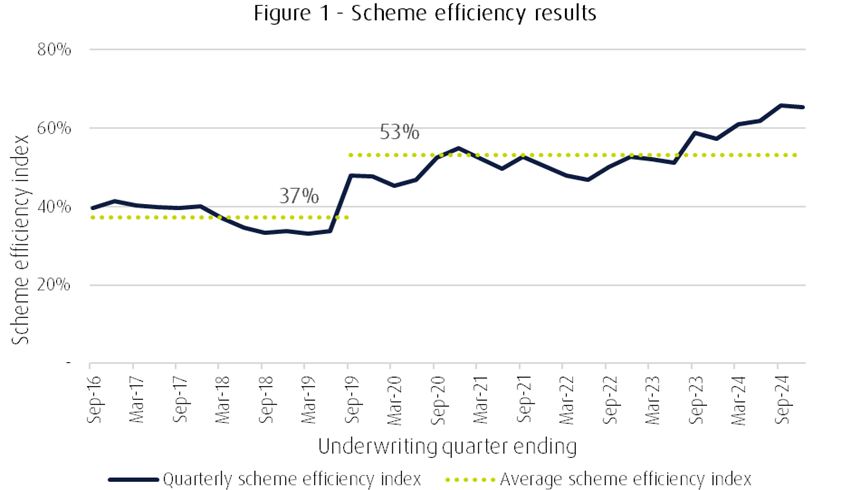
Source: CTP Scheme Efficiency Report as at 31 December 2024 (PDF)
Understanding claimant experience supports the Regulator to monitor the CTP Scheme and identify improvements. To gain this understanding, the Regulator continuously surveys injured people about their experience with the CTP Insurer managing their claim (see page 23 for more detail on the claimant service rating).
This regular surveying is periodically supplemented by research into different aspects of scheme experience. In 2024-25, the Regulator delved deeper into injured people’s recovery experiences, learning more about which treatment providers were involved in their recovery and what that experience was like.
Two-thirds of respondents agreed the CTP Scheme is able to support injured people with their recovery and 80% felt their treatment providers had adequate knowledge of the Scheme. While these results are positive, there is room for improvement with injured people explaining that being given more information about recovery from treatment providers and having more time with providers would improve their recovery experience. Some other insights that injured people offered for improving their scheme experience included better communication and understanding from insurers and faster processes to help return them to usual life.
The Regulator also sought feedback from those working at CTP Insurers to coordinate the treatment, care and support of injured people. Insurer staff have a positive view of the Scheme, with almost 90% believing the Scheme is able to support injured people with their recovery. Insurer staff view a key strength of the Scheme is the focus on early access to treatment which helps injured people recover faster. Like injured people, insurer staff thought better communication and faster processes deliver a better scheme experience. Additional suggestions to benefit everyone interacting with the Scheme included raised awareness of the CTP Scheme, further supports to help injured people through the claim process and greater numbers of and access to treatment providers and medical assessors.
The feedback from injured people and insurer staff will be used to help inform the Regulator’s initiatives for the coming year, which will focus on working with stakeholders to enhance the experience of the Scheme.
The Regulator explored opportunities to use scheme data to gain insights that would improve the oversight of insurers in the Scheme and promote improvements in claimant experience and outcomes.
This work aimed to:
- determine whether additional data could be gathered from insurers to be used for scheme monitoring in the area of injury recovery and early intervention.
- understand how injured people return to work over the life of their claim and how they are supported by the insurers and other stakeholders to do so.
- develop new metrics based on new or existing data to improve understanding of how treatment and care is being used in the Scheme and how it is changing over time.
- create predictive models of key claim outcomes such as claim duration.
Increased oversight of insurers’ support of claimants to return to functional capacity (which may include returning to work) and oversight of insurer identification of injured people who may require additional supports will assist the Regulator to monitor and potentially uplift claimant outcomes in the Scheme.
The Regulator reviewed the Allied Health Management Plans to identify enhancements that would improve efficiencies in the Scheme, support injured people with receiving reasonable and necessary treatment sooner and with better outcomes.
Extensive consultation with allied health providers and CTP Insurers, alongside a review of similar plans nationally, guided the review. It was identified that there was an opportunity to enhance the quality and clarity of the information being provided to insurers to provide a more holistic view of the injured person’s recovery and support timely funding decisions.
New management plans are now in place and are accessible on the CTP website (Allied Health Management Plans | CTP Insurance Regulator) in user-friendly formats. A guide has also been released to support allied health providers to provide the information required in the management plans.
Key changes to the plans include:
- restructuring to enhance usability
- expanding the funding request section to ensure treatment requests are clear
- adding new sections such as clinical examination findings, functional ability assessment, and estimated discharge date to provide additional information to support insurers to make well-informed and timely funding decisions.
These improvements support a more streamlined, holistic and evidence-based approach to supporting injury recovery through reasonable and necessary treatment.
The Regulator developed an artificial intelligence (AI) based process to analyse claimant service rating survey responses to categorise unfavourable survey responses and create
de-identified summaries of positive responses to support improvement of claims management in the Scheme.
This AI analysis was a success and is now being put into practice to support Regulator staff manually conducting this work. The results of this project will assist CTP Insurers in finding ways to improve their customer service and support the Regulator in recognising ways AI may further enhance efficiency and improve insights in the Scheme.
The Regulator’s AI program is underpinned by robust governance processes to respect the feedback and protect the privacy of survey respondents. Protocols are in place to ensure responses remain confidential.
The Regulator is involved in state and national conversations about developing a framework to support the deployment of automated vehicles (AVs). AVs have the potential to change road transport through enhancements in safety, increased access to transport and reducing traffic congestion.
Existing transport laws across Australia are designed for conventional vehicles with human drivers. Before AVs can be deployed, new laws will be required to effectively manage their safety and support integration into the existing road network.
On a national level, this work is being led by the National Transport Commission. At a state level, the Department for Infrastructure and Transport is leading work on the legislative framework to support the safe deployment and operation of AVs.
The Regulator contributes to both state and national conversations to ensure CTP Scheme considerations are addressed. The CTP Regulator also engages in cross-jurisdictional discussions with other CTP and lifetime support schemes to promote a consistent approach to AVs where possible. The key principle guiding this work is to ‘ensure no person is better or worse off, financially or procedurally, in the relevant jurisdiction, if they are injured by a vehicle whose ADS was engaged than if they were injured by a vehicle controlled by a human driver.’
For more information, see Automated vehicle program | National Transport Commission (external site).
- Published updated data to the Scheme Data Dashboard. The Dashboard provides an overview of the Scheme, including CTP claims and insurer premiums from 1 July 2016 up to 31 December 2024. The dashboard is updated annually.
- Published the annual 2025-26 SA CTP Market Briefing (PDF) prepared by the independent scheme actuary, which informs the premium setting process.
The Regulator has strengthened collaboration with allied health providers, who play a key role in claimant recovery and experience of the Scheme.
In November 2024, the Regulator hosted a Whiplash Education Forum, presented by internationally recognised researchers and clinicians, Professors Michele Sterling and Trudy Rebbeck. These world-class experts provided South Australian clinicians with the opportunity to enhance their skills in the assessment and management of whiplash-related injuries—a common injury type in the Scheme.
The forum, supported by ReturntoWorkSA, was attended by over 70 allied health providers, students, general practitioners and CTP Insurer claims/injury management specialists. Attendees were given an in-depth overview of the latest draft whiplash guidelines, emphasising evidence-based best practice in assessment and management. The forum also included a practical session which provided an opportunity to engage directly in case studies, apply clinical reasoning, and to practise assessment and management techniques.
The forum enabled the Regulator to engage with service providers who treat injured people within the Scheme and gain valuable insights into their experiences. This insight is crucial for identifying areas where the Scheme may be able to improve the experience of treatment providers and injured people, leading to better injury recovery outcomes.
To maximise the benefit from the forum and the presenters’ knowledge, recordings from the forum have been made available on the Regulator’s website: www.ctp.sa.gov.au.

In the CTP Scheme, an injured road user may be entitled to compensation for their injures. Some types of compensation, including non-economic loss and compensation for gratuitous services, are subject to thresholds based on the Injury Scale Value (ISV) of the injuries.
The South Australian Motor Accident Injury Accreditation Scheme (MAIAS) accredits medical practitioners to undertake ISV medical assessments (Assessments) that assist in determining an injured person’s entitlement to compensation.
The objective of the MAIAS is to create an independent system that provides consistent, objective and reliable Assessments. The MAIAS accredits medical practitioners (AMPs) to undertake Assessments which includes assigning ISV Item Numbers for each injury. The reports from these Assessments assist injured people and CTP Insurers in the claims settlement process.
The MAIAS Rules set out the regulatory and service standards that AMPs must meet to obtain and retain accreditation under MAIAS and to fulfill its purpose.
To be accredited under the MAIAS, medical practitioners must first be accredited as an Impairment Assessor in the ReturnToWorkSA (RTWSA) scheme. The MAIAS collaborates with RTWSA to maintain an integrated process for application, training and developing assessor capability and has an interest in RTWSA’s Impairment Assessor Accreditation scheme more broadly.
This past year, the team reviewed the existing MAIAS quality assurance (QA) process from start to end to identify opportunities for improved efficiencies and consistency for Regulator staff, MAIAS medical peer reviewers and AMPs. This included a review of the QA audit criteria to ensure an increased focus on areas that have a meaningful impact for the injured person.
Following the review, a new QA system was developed to standardise reviews and strengthen information security. It was also developed with the end-user in mind, to ensure that AMPs are provided with clear and meaningful feedback about their results.
The new system will be used to conduct the QA process during 2025-26.
Regulation 23(2) of the Civil Liability Regulations 2013 (CLR) requires Assessments to be reported using the prescribed Injury Scale Value Medical Assessment (ISVMA) report templates. These templates are approved by the Minister and published by the MAIAS Administrator in the MAIAS section of the Regulator website: www.ctp.sa.gov.au/maias.
The templates must be used as published and all questions must be answered in full in accordance with MAIAS Rule 7 and regulation 23 of the CLR.
On 24 June 2025, new Report templates were issued. The updated templates provide clearer instruction and guidance to support AMPs to provide consistent, quality reports. A FAQ document (PDF) for AMPs addressing the changes in more detail is also available in the MAIAS section of the Regulator website.
Insured vehicles by type
(Registrations as at 30 June 2025)
Type of vehicle | Vehicles | % |
|---|---|---|
Private passenger | 1,161,702 | 56.65% |
Public passenger: no fare | 648 | 0.03% |
Taxis: metropolitan | 964 | 0.05% |
Taxis: country | 234 | 0.01% |
Hire cars | 11,198 | 0.55% |
Rideshare: country | 5 | 0.00% |
Rideshare: metropolitan | 5,280 | 0.26% |
Public passenger: small | 760 | 0.04% |
Public passenger: medium | 1,097 | 0.05% |
Public passenger: heavy | 708 | 0.03% |
Public passenger: omnibus | 1,039 | 0.05% |
Goods carrying: light | 260,763 | 12.72% |
Goods carrying: medium | 16,876 | 0.82% |
Goods carrying: heavy | 11,786 | 0.57% |
Goods carrying: primary producers | 30,619 | 1.49% |
Motorcycles: ultra light | 2,935 | 0.14% |
Motorcycles: light | 7,917 | 0.39% |
Motorcycles: medium | 14,218 | 0.69% |
Motorcycles: heavy | 21,205 | 1.03% |
Tractors | 53,207 | 2.59% |
Historic and left hand drive vehicles | 50,871 | 2.48% |
Special purpose vehicles | 17,934 | 0.87% |
Car carriers: light | 3 | 0.00% |
Car carriers: medium | 17 | 0.00% |
Car carriers: heavy | 1 | 0.00% |
Car carrier trailers | 127 | 0.01% |
Trailers | 376,331 | 18.35% |
Unregistered vehicle permits | 90 | 0.00% |
Motor trade plate | 2,120 | 0.10% |
Total | 2,050,655 | 100.00% |
Source: Department for Infrastructure and Transport policy data.
Ratio of class 1 premium(1) to South Australian average weekly earnings (AWE)(2)
Annual premium(1) | State AWE(2) | Ratio | |
|---|---|---|---|
2024-25 | $260.71 | $1,857 | 14% |
2023-24 | $270.78 | $1,735 | 16% |
2022-23 | $294.99 | $1,658 | 18% |
2021-22 | $290.33 | $1,591 | 18% |
2020-21 | $295.40 | $1,543 | 19% |
2019-20 | $296.77 | $1,504 | 20% |
2018-19 | $411.25 | $1,462 | 28% |
(1) Note: Premium is the weighted average lowest priced Class 1 District 1 public passenger vehicle (private use, no input tax entitlement) on offer over the financial year.
(2) Source: Australian Bureau of Statistics, 6302.0 Average Weekly Earnings, Australia. Earnings; Persons; Full Time; Adult; Ordinary time earnings; South Australia; Series Id: A84989336X, November (in given financial year).
Premium and fee collection
(1 July 2024 to 30 June 2025)
Description | $'000 |
|---|---|
Insurers' premiums* | 304,878 |
Stamp duty | 41,754 |
Road safety | 14,063 |
Emergency transport, hospital and forensic services | 41,309 |
Customer support and transaction processing | 11,598 |
CTP Scheme regulation and administration | 6,269 |
Total insurance premiums collected | 419,872 |
Note: *Includes GST.
Market share of in-force premium
| AAMI | Allianz | NRMA | QBE | Youi† |
|---|---|---|---|---|---|
30 June 2025 | 27% | 15% | 29% | 23% | 6% |
30 June 2024 | 29% | 21% | 19% | 26% | 5% |
30 June 2023 | 32% | 7% | 25% | 29% | 7% |
30 June 2022 | 40% | 9% | 30% | 21% | |
30 June 2021 | 20% | 18% | 41% | 21% | |
30 June 2020 | 28% | 27% | 24% | 21% | |
30 June 2019* | 30% | 15% | 20% | 35% |
Note: *All insurers had contractually agreed market share for the first three years of the privately underwritten scheme – 2016 to 2019.
†Youi entered the scheme on 1 July 2022.
Number of changes to filed premiums 2024-25
Type of vehicle | District 1 | District 2 |
|---|---|---|
Private passenger | 3 | 1 |
Public passenger: no fare | 2 | 2 |
Taxis: metropolitan | 2 | |
Taxis: country | 2 | |
Hire cars | 3 | 3 |
Rideshare: country | 2 | |
Rideshare: metropolitan | 1 | |
Public passenger: small | 2 | 2 |
Public passenger: medium | 2 | 2 |
Public passenger: heavy | 2 | 2 |
Public passenger: omnibus | 2 | |
Goods carrying: light | 1 | 1 |
Goods carrying: medium | 3 | 4 |
Goods carrying: heavy | 3 | 2 |
Goods carrying: primary producers | 5 | 2 |
Motorcycles: ultra light | 2 | 2 |
Motorcycles: light | 2 | 2 |
Motorcycles: medium | 2 | 2 |
Motorcycles: heavy | 2 | 3 |
Tractors | 3 | 3 |
Historic and left hand drive vehicles | 3 | 3 |
Special purpose vehicles | 4 | 4 |
Car carriers: light | 1 | 1 |
Car carriers: medium | 2 | 1 |
Car carriers: heavy | 2 | 1 |
Car carrier trailers | 2 | 1 |
Unregistered vehicle permits | 1 | 1 |
Total | 61 | 45 |
This is an indicator of premium price competition in the CTP scheme. Premium classes for taxis, rideshare and omnibuses do not depend on the district, but are counted with district 1 in the table.
Claimant service rating results
Publication month | AAMI | Allianz | NRMA | QBE | Youi† |
|---|---|---|---|---|---|
June 2025 | 87 | 84 | 85 | 79 | 85 |
June 2024 | 82 | 81 | 80 | 83 | 79 |
June 2023 | 84 | 75 | 77 | 77 | |
June 2022 | 84 | 78 | 74 | 80 | |
June 2021 | 77 | 78 | 79 | 75 | |
June 2020 | 81 | 72 | 85 | 77 | |
June 2019 | 69 | 72 | 70 | 71 |
Note: The score published each month is the average claimant service rating from claimants surveyed in the previous six months.
†Youi entered the scheme on 1 July 2022, but didn’t have a published CSR score until they had had enough claimants who had been surveyed to give them a representative sample.
Number of accidents by region
(Accidents from 1 July 2024 to 30 June 2025)
Region | Accidents | % |
|---|---|---|
Adelaide City / Suburbs | 1,462 | 87.0% |
Outer Adelaide | 96 | 5.7% |
Murraylands | 32 | 1.9% |
South | 23 | 1.4% |
Northern | 10 | 0.6% |
Eyre | 12 | 0.7% |
Interstate | 45 | 2.7% |
Total | 1,680 | 100.0% |
Note: The recent accident years’ data is immature due to accidents where a claim is yet to be reported.
Claim lodgement by development year
(All claims for accidents from 1 July 2016 to 30 June 2025)
Accident year | Development year | ||||||
|---|---|---|---|---|---|---|---|
1 | 2 | 3 | 4 | 5 | 6+ | Total | |
2016-17 | 2,377 | 630 | 49 | 29 | 16 | 7 | 3,108 |
2017-18 | 2,115 | 470 | 56 | 21 | 5 | 10 | 2,677 |
2018-19 | 1,934 | 427 | 45 | 18 | 15 | 11 | 2,450 |
2019-20 | 1,556 | 342 | 52 | 31 | 18 | 22 | 2,021 |
2020-21 | 1,727 | 436 | 29 | 31 | 5 | 2,228 | |
2021-22 | 1,536 | 368 | 50 | 22 | 1,976 | ||
2022-23 | 1,593 | 355 | 59 | 2,007 | |||
2023-24 | 1,864 | 392 | 2,256 | ||||
2024-25 | 1,923 | 1923 | |||||
Total |
|
|
|
|
|
| 20,646 |
Note: Development year 1 means claims lodged in the accident year (year means financial year), development year 2 means claims lodged in the next year after the accident year, etc.
Claims by current status
(All claims for accidents from 1 July 2016 to 30 June 2025)
Accident year | Claims lodged | Claims open | Claims closed | % closed |
|---|---|---|---|---|
2024-25 | 1,923 | 1,407 | 516 | 27% |
2023-24 | 2,256 | 983 | 1,273 | 56% |
2022-23 | 2,007 | 539 | 1,468 | 73% |
2021-22 | 1,976 | 317 | 1,659 | 84% |
2020-21 | 2,228 | 201 | 2,027 | 91% |
2019-20 | 2,021 | 115 | 1,906 | 94% |
2018-19 | 2,450 | 57 | 2,393 | 98% |
2017-18 | 2,677 | 41 | 2,636 | 98% |
2016-17 | 3,108 | 26 | 3,082 | 99% |
Claimants by demographic
(All claims for accidents from 1 July 2016 to 30 June 2025)
Age group | Males | Females | Total | % | |
|---|---|---|---|---|---|
16 years and under | 468 | 503 | 976 | 5% | |
17 to 24 years | 1,064 | 1,435 | 2,513 | 12% | |
25 to 34 years | 1,766 | 2,229 | 4,005 | 19% | |
35 to 44 years | 1,690 | 2,063 | 3,768 | 18% | |
45 to 54 years | 1,775 | 2,002 | 3,788 | 18% | |
55 to 64 years | 1,469 | 1,526 | 3,005 | 15% | |
65 years and over | 1,102 | 1,475 | 2,586 | 13% | |
Unspecified | 3 | 2 | 5 | 0% | |
Total | 9,337 | 11,235 | 20,646 | 100% | |
Claimants by accident role
(All claims for accidents from 1 July 2016 to 30 June 2025)
Role | Claims | % |
|---|---|---|
Driver | 13,075 | 63% |
Passenger | 4,421 | 21% |
Bicyclist | 1,441 | 7% |
Pedestrian | 1,375 | 7% |
Other | 334 | 2% |
Total | 20,646 | 100% |
Claims by severity
(Closed claims for accidents from 1 July 2016 to 30 June 2025)
AIS* severity | Claims | % |
|---|---|---|
Minor | 10,985 | 64.8% |
Moderate | 2,261 | 13.3% |
Serious | 882 | 5.2% |
Severe | 85 | 0.5% |
Critical | 35 | 0.2% |
Maximum | 264 | 1.6% |
Admin only | 2,448 | 14.4% |
Total | 16,960 | 100.0% |
Note:
*Injury severity based on injuries coded under the Abbreviated Injury Scale (AIS) 2005 and the Update 2008 Manual.
“Minor” category includes claims where a region-specific injury code was reported with a severity of 9 (“not further specified”).
“Maximum” injury severity usually indicates a fatality.
“Admin” means there were no physical injuries caused by the accident or there was no medical evidence available for injury coding.
Claims by dominant injury body region
(Closed claims for accidents from 1 July 2016 to 30 June 2025 excluding claims without a dominant injury recorded)
Body region | Claims | % | |
|---|---|---|---|
Cervical spine | 3,957 | 25% | |
Shoulder | 3,341 | 21% | |
Thoracic spine or lumbar spine | 2,047 | 13% | |
Other | 1,571 | 10% | |
Pelvis or hip | 1,210 | 8% | |
Other lower limb | 825 | 5% | |
Pure mental harm | 765 | 5% | |
Knee | 733 | 5% | |
Central nervous system and head | 627 | 4% | |
Wrist | 434 | 3% | |
Chest | 433 | 3% | |
Total | 15,943 | 100% | |
Rates of legal representation
(Accidents from 1 July 2016 to 30 June 2025)
Accident year | Claims | % Legal rep | % Litigated | % Trial |
|---|---|---|---|---|
2024-25 | 1,923 | 22% | 0% | 0.00% |
2023-24 | 2,256 | 31% | 0% | 0.00% |
2022-23 | 2,007 | 35% | 1% | 0.00% |
2021-22 | 1,976 | 36% | 9% | 0.00% |
2020-21 | 2,228 | 39% | 17% | 0.04% |
2019-20 | 2,021 | 40% | 17% | 0.00% |
2018-19 | 2,450 | 35% | 15% | 0.00% |
2017-18 | 2,677 | 41% | 17% | 0.04% |
2016-17 | 3,108 | 41% | 20% | 0.03% |
Note: The recent accident years’ data is immature due to the long tail nature of CTP claims.
Legal costs
(All legal cost payments for accidents from 1 July 2016 to 30 June 2025)
Accident year | Solicitor client costs | Plaintiff - Legal ($'000) | Defendant - Legal ($'000) | Grand total ($'000) |
|---|---|---|---|---|
2024-25 | Unknown | 5 | 85 | 90 |
2023-24 | Unknown | 590 | 356 | 946 |
2022-23 | Unknown | 3,204 | 1,192 | 4,395 |
2021-22 | Unknown | 6,917 | 2,817 | 9,733 |
2020-21 | Unknown | 11,325 | 6,230 | 17,555 |
2019-20 | Unknown | 13,194 | 6,455 | 19,649 |
2018-19 | Unknown | 14,908 | 7,762 | 22,671 |
2017-18 | Unknown | 20,185 | 10,527 | 30,712 |
2016-17 | Unknown | 21,108 | 12,860 | 33,969 |
Total |
| 91,436 | 48,284 | 139,720 |
Note: Solicitor client costs are unknown because there is no legal requirement for solicitors to provide their solicitor client costs to the managing insurer of a claim and so they are not reported to the CTP Regulator.
Claim duration by CTP Insurer
(Closed claims for accidents from 1 July 2016 to 30 June 2025 where relevant data is available)
Timeframe | AAMI | Allianz | NRMA | QBE | Average |
|---|---|---|---|---|---|
Notification date to liability decision date | 3.9 | 3.2 | 3.7 | 3.8 | 3.7 |
Notification date to closure date | 17.6 | 20.2 | 17.2 | 19.7 | 18.4 |
Note: Timeframe is average months. Youi’s claim portfolio is currently underdeveloped to compare with the rest of industry.
Breakdown by heads of damage
(Closed claims from 1 July 2023 to 30 June 2025 for accidents from 1 July 2016 to 30 June 2025)
Heads of damage | Closed claims | Total ($’000) | % Closed payments |
|---|---|---|---|
Economic Loss | 996 | $96,845 | 47.9% |
Non Customer Benefits | 1,852 | $40,824 | 20.2% |
Treatment | 2,127 | $28,491 | 14.1% |
Care | 946 | $22,432 | 11.1% |
Non-Economic Loss | 438 | $11,756 | 5.8% |
Other Customer Benefits | 735 | $1,897 | 0.9% |
Total | 2,294 | $202,245 | 100.0% |
Note:
“Care” category includes payments for past and future care and home services, care-related travel and voluntary services.
“Non-customer benefits” category includes investigation costs, the costs of medical reports from treating medical providers and ISV medical assessors, and plaintiff and defendant legal costs.
“Other customer benefits” category includes claimant travel expenses and reasonable funeral costs.
“Treatment” category includes payments for past and future medical, allied health and hospital services, excluding public hospital services funded from the administrative fee component of CTP premiums.
Nil claims (zero payments) have been excluded from the data.
Nominal defendant claims received by accident year
(Accidents from 1 July 2016 to 30 June 2025)
Year of accident | Unidentified vehicles | Unregistered vehicles | Total |
|---|---|---|---|
2024-25 | 67 | 16 | 83 |
2023-24 | 76 | 12 | 88 |
2022-23 | 56 | 13 | 69 |
2021-22 | 61 | 12 | 73 |
2020-21 | 70 | 12 | 82 |
2019-20 | 60 | 11 | 71 |
2018-19 | 71 | 10 | 81 |
2017-18 | 78 | 14 | 92 |
2016-17 | 95 | 11 | 106 |
Note: The recent accident years’ data is immature due to accidents where a claim is yet to be reported.
Data has changed slightly for previous years since last year’s annual report due to data cleanup.
Communications
Type | Number of instances | |
Complaints about CTP Insurers | 17 | |
Complaints about the Scheme | 0 | |
Complaints about the Motor Accident Injury Accreditation Scheme (MAIAS) | 0 | |
Complaints about the Regulator | 0 | |
Total | 17 | |
Enquirer source | Number of enquiries |
General public | 1,885 |
CTP Insurer | 460 |
Medical | 299 |
Legal | 129 |
Government Department | 76 |
Other | 26 |
Total | 2,875 |
Type | Average time taken to be resolved (in business days) |
Enquiries and feedback | 0.4 |
Complaints | 7 |
Enquiry category | Number of enquiries |
Claims | 913 |
CTP Scheme | 131 |
Non-CTP-related enquiries* | 210 |
Operations | 185 |
Suspected fraud, scamming or deception | 58 |
Nominal Defendant | 159 |
Complaints | 39 |
MAIAS | 13 |
Total | 1,708 |
Note: *Enquiries about topics outside of the Regulator’s scope, for example, comprehensive vehicle insurance, vehicle registration, or road safety.
The number for ‘complaints’ does not match the number of complaints listed in the public complaints section of this annual report because each complaint can involve multiple interactions. This category also includes questions about the complaints process that do not result in a formal complaint being lodged with the Regulator.
In line with Premier and Cabinet Circular 39 - Complaint Management in the South Australian Public Sector, the Regulator has reviewed its Complaint Management System during 2024-25. This review resulted in improvements including the re-introduction of a quality assurance program on a quarterly basis that reviews a subset of standard enquiries and all non-standard enquiries and complaints.
Compliance Statement
The CTP Regulator is compliant with Premier and Cabinet Circular 039 – complaint management in the South Australian public sector. | Y |
The CTP Regulator has communicated the content of PC 039 and the agency’s related complaints policies and procedures to employees. | Y |