
For experts, the understanding of how pain works has changed a lot in the last 50 years. You may find it surprising and even challenging, but evidence shows that a basic understanding of the new way of thinking about pain is helpful for your recovery.
Many studies have shown that multiple factors influence when and how you might experience pain following a motor vehicle accident. Given pain is one of the most important ways the body protects you from further tissue damage, the brain uses all available information to inform your pain experience. This modern understanding of the pain experience is based on the biopsychosocial model, which was developed to acknowledge the many contributing factors.
The below diagram shows the ways in which biopsychosocial factors overlap and can inform your pain experience. 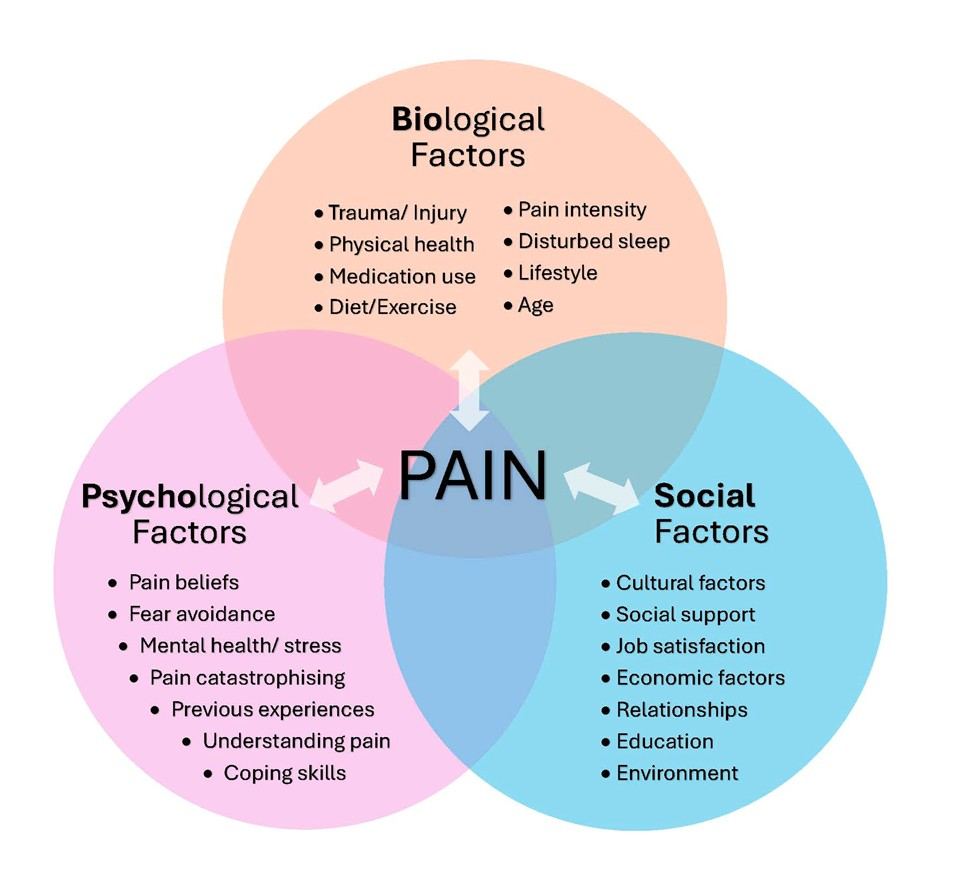
* Source cited below
Your thoughts, beliefs and understanding matter
If you consider how the body works, your thoughts and beliefs involve nerve impulses, just like body movements do. This is how your thoughts, beliefs and understanding about pain influence your experience, how you respond to your pain and how you choose to manage it.
Your pain beliefs are influenced by many things, including your thoughts, understanding and past experiences. These beliefs can be difficult to change, often requiring repeated, conscious efforts to challenge them. Recognising pain beliefs that are helpful and unhelpful for your recovery can be an important first step to take.
Many of the common beliefs about pain are not necessarily right or wrong. Based on your own personal circumstances they do, however, have the potential to limit or slow down your recovery. If you relate to any of the common beliefs described below, discuss them with your healthcare professional(s) who can help you understand how they may be influencing your experience and recovery.
- I need to rest until the pain is gone
- I should completely avoid movements and activities that are painful
- If it hurts while I am resting, the tissue damage must be bad
- If it hurts more when I move, I must be doing more damage
- I need a scan to identify the source of my pain
- I need a blood test to identify the cause of my pain
- No pain, no gain
- Medication is the only way to manage my pain
- Other people think the pain is all in my head
The video below, by Pain Scientist Prof. Lorimer Moseley, further explains the influence beliefs have on the pain experience and how you can think differently about your pain.
Resources
- To understand more about your pain experience and how you can rethink pain, visit the Tame the Beast and painHealth websites.
- The journal article, Beliefs about the body and pain: the critical role in musculoskeletal pain management discusses more about beliefs and the role they plan in your pain experience.
* Content sourced from “Measuring Biopsychosocial Risk for Back Pain Disability in Chiropractic Patients Using the STarT Back Screening Tool: A Cross-sectional Survey” by YvKhan, D Lawrence, R Vining and D Derby, National Library of Medicine, [2019].
Licensed under CC BY‑SA 4.0
Source: https://chiro.org/LINKS/ABSTRACTS/Measuring_Biopsychosocial_Risk.shtml